Background: The typical Product Life Cycle classifies the following stages of a Product: Introduction, Growth, Maturity & Decline. Many of us would have come across this classical definition in Marketing textbooks. However, in this post, we would look at another classification of a Product’s journey – this time from the lens of a Product Manager. Here, we would look at evolution of a Product over time across an alternate set of labels.
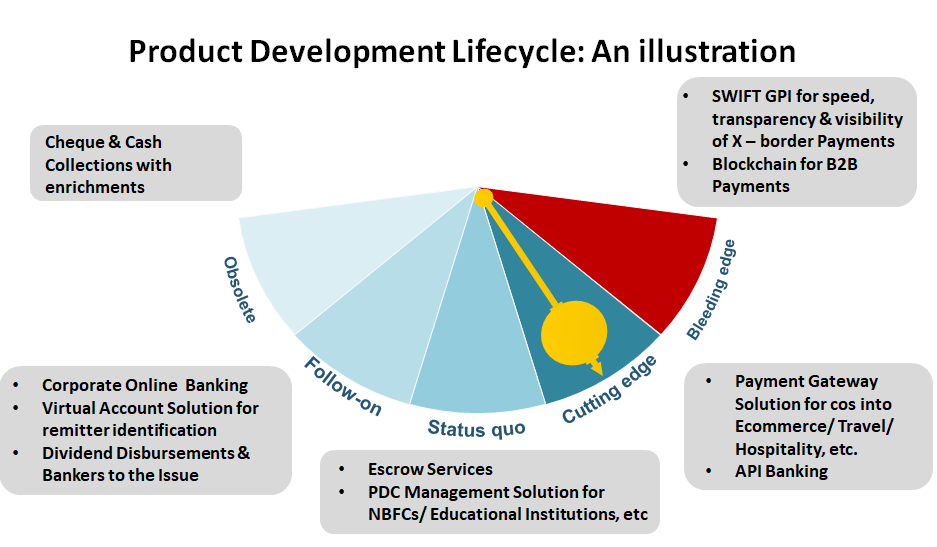
Details: The categories we are going to use are: Obsolete, Follow – on, Status quo, Cutting edge & Bleeding edge. The use case taken is of a Product Manager handling Corporate Cash Management, who has joined an organisation (typically a bank) where the business is in its infancy. As part of the career journey, he/ she gets a chance to lead the transition of the organisation from a basic Solution Provider (‘Obsolete’) to one at a highly evolved stage (‘Cutting Edge’) in terms of its Solutioning Capabilities.
Next stage: The next stage is defined as ‘Bleeding edge’ of the Product Lifecycle, where the organisation would be able to have an edge over its peers in terms of Deal Solutioning and can justifiably stake a claim to being a true partner of Corporate clients/ Financial Institutions.
Illustration: The attached slide illustrates this. In case of other Businesses/ Product lines, the journey can be explained by using appropriate examples showing how the Product/ Service has evolved over time.
What are your views on this? Have you observed an organisation transform from one offering ‘Obsolete’ Products to one at the ‘Bleeding Edge’ of Product Development? If yes, over what period has it happened?
Do keep reading this space for more on Product Management….
 Product Management Toolkit